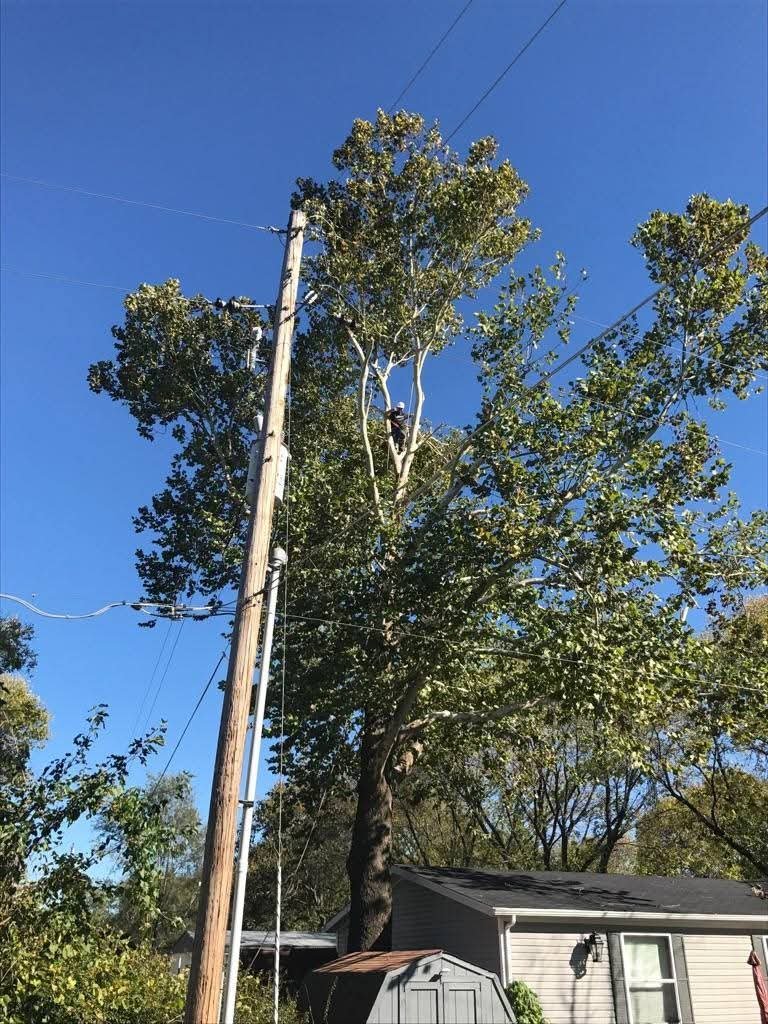
Here is the short version. Evergy trims trees around the power lines that run from pole to pole. The line that runs from the pole to the meter on your house is your responsibility, and so is the rest of the tree. To ask Evergy to look at a tree near its lines, call 888-471-5275 or submit a vegetation request on Evergy's website. An inspector comes out to judge how close the tree is to the line, and Evergy told the Kansas City Star in 2024 that it aims to visit within 7 to 14 days, longer after major storms. Two more things catch Topeka homeowners off guard: Evergy prunes for clearance, not for how the tree looks, and the limbs often stay in your yard for you to deal with.
Below is who handles which line, how the request works, what Evergy leaves behind, what Kansas law says about working near power lines, and where a private tree crew fits in.
Which Lines Evergy Trims and Which Ones Are Yours
Most of Topeka is served by Evergy, and its rule is simple once you know where to look. On its help page, Evergy says it handles vegetation on the lines that run from pole to pole near your house. Vegetation affecting the line that runs from a pole to your meter is the customer's responsibility.
| Line | Who handles the trees | What to do |
|---|---|---|
| Power lines running pole to pole along the street or alley | Evergy | Report it to Evergy. Do not cut near it yourself or hire someone to |
| The service line from the pole to your meter | You, the property owner | Hire a tree crew, and talk to Evergy first if limbs are touching or resting on the line |
| Cable, internet and phone lines | Not part of Evergy's power line program | Call the company that provides that service |
Telling the lines apart is harder than it sounds. David Martin, who oversees Evergy's tree crews, told the Kansas City Star that about two thirds of the calls his team gets are not about power lines at all but about branches near communication wires. He also said it is hard for most people to tell a charged power line from a cable or phone line on the same pole, so if you are not sure, report it and let Evergy check.
If your electric bill comes from a rural electric cooperative instead of Evergy, call the co-op. Its rules for who trims what may be different.
How to Request Evergy Tree Trimming
You have two ways to ask Evergy to look at a tree:
- Call 888-471-5275. This is the number Evergy lists for reporting vegetation on the lines near your house.
- Submit an online vegetation request through Evergy's website, which asks for an inspector to check the tree in person.
What happens next, based on what Evergy has said publicly:
- An inspector comes out first. Evergy sends someone to review how close the vegetation is to the line and takes action if it decides action is needed. Not every request leads to trimming.
- Hazards jump the line. Evergy told the Star it prioritizes requests by how immediate the hazard is, so a dead tree or a hanging limb over a line gets attention before a branch that is merely getting close.
- Plan on one to two weeks. The stated turnaround for an assessment is 7 to 14 days, and it can stretch after severe weather, which is exactly when everyone else is calling too.
Evergy also trims on a schedule. According to the Star, its contract crews work about 6,000 miles of line per year and cycle through the whole system every five to six years. If a tree has been growing toward the line for a few seasons and nobody has been by, that cycle may be why. Calling it in is how you get it looked at sooner.
If Evergy wants to take the whole tree
Sometimes the inspector decides a tree should come down instead of being trimmed again. Evergy needs the landowner's permission for a full removal, and Martin said about 80 percent of private landowners never give it, many by simply not answering. Before you say no, think about the tree honestly. A tree that has been notched around a line for twenty years will keep needing it. Before you say yes, ask what will be left behind: the wood, the brush and the stump.
What Evergy Leaves Behind
This is the part that surprises people. Evergy is clearing its lines, not doing yard work, and its cleanup reflects that.
- After an outage. Evergy's tree trimming page says that when crews trim to restore power, they knock to let you know they are on your property, clear what is interfering with the lines, and ask you to clean up the outage debris so they can move on to restoring power. Evergy's own suggestion is to hire a tree or lawn care company, and it notes that many cities offer debris pick up or drop off after major storms.
- On routine trimming. In a 2025 notice to residents, the City of Mission Hills described Evergy as generally pruning for at least 10 feet of clearance around its lines and said its normal procedure is to leave removed limbs on site for the property owner. Ask the crew on your street what they plan to haul away before they start.
- Free mulch. Evergy offers free tree mulch from its trimming work when it is available, through a mulch request form on its website.
If you are left with a pile of limbs along the curb or the back fence, that is a brush removal or tree debris removal job. If a tree came down and left a stump, we can follow up with stump grinding.
Why Utility Pruning Looks the Way It Does
Utility crews have one job: keep limbs away from the wire. They are not shaping your tree, balancing its crown or making it look good from the street. That is why trees under lines in older Topeka neighborhoods often end up with a deep notch through the middle or a crown that is all on one side.
The fix is not to cut back toward the line. That part is Evergy's. What you can control is the rest of the tree:
- Removing dead wood and broken stubs left in the interior
- Reducing long, heavy limbs on the side away from the line so the tree is not lopsided over your roof or driveway
- Checking the cuts and the main unions for cracks or decay that a clearance crew had no reason to look at
- Deciding whether a tall tree directly under the line is worth keeping at all
That is tree pruning work, done away from the line. If you are not sure whether a notched tree is still sound, a tree consultation will give you a straight answer.
The Kansas 10 Foot Rule
Kansas has a law on this, the Overhead Power Line Accident Prevention Act, and it applies to homeowners, contractors and tree crews alike.
- The 10 foot limit. K.S.A. 66-1711 says no person may operate or move tools, equipment or materials within 10 feet of a high voltage overhead line, or do any work where it is reasonably foreseeable that someone could end up within 10 feet of one, unless the danger has been guarded against first.
- What counts as high voltage. K.S.A. 66-1710 defines it as more than 600 volts. The lines running pole to pole are the ones this rule is written for.
- How to work legally. K.S.A. 66-1712 says the person responsible for the work has to notify the utility and arrange temporary barriers, de-energizing and grounding, rerouting of the current or relocating of the lines before the work starts.
- Timing and cost. The same statute says the utility should start that work within seven working days unless something else is agreed or keeping service running requires longer. The person requesting it pays only for rerouting the current or relocating the lines, and can ask for a written cost estimate first.
In plain terms: if anyone offers to climb up and "just clip" limbs off the high voltage lines without involving Evergy, that is your sign to keep looking. The service line to your house carries less voltage than the statute's threshold, but it is still live and still dangerous. When limbs are tangled in it or lying on it, talk to Evergy about the line before anyone cuts. We will tell you on site whether a job needs Evergy involved first.
What You Can Do Yourself, and What You Should Not
Reasonable for a homeowner:
- Picking up and hauling the limbs Evergy left on the ground
- Trimming small branches that are well clear of every line, from the ground
- Reporting a dead or leaning tree near the lines to Evergy before it fails
- Planting new trees where their mature height will never reach a line
Leave alone:
- Anything you would have to climb, or reach with a pole saw or ladder, near any overhead line
- A limb that is touching or resting on a line, including the service line to your house
- Any line that is down after a storm. Treat it as live, stay well away from it and anything it touches, and report it to Evergy
Why Late Fall Is a Good Time to Look Up
Once the leaves drop, you can see exactly where limbs sit relative to the lines, which is hard to judge in July. It is also the last good window before ice season. As we cover in our Kansas storm preparation guide, ice adds a lot of weight to a tree, and a limb that clears the line on a dry day can sag onto it under a coat of ice. With a 7 to 14 day assessment window that gets longer after storms, the time to call Evergy about a limb over the line is before the forecast turns, not after.
For your own trees, a fall walk around the yard is also the time to spot limbs drifting toward the service line to your house. That one is on you, and it is much easier to handle on a calm day than after it has pulled the line off the house.
Where Wiki Wood Tree Care Fits In
We do not trim Evergy's pole to pole lines. That is Evergy's job, and Kansas law says so. Here is where we come in:
- Clearing the brush and limbs left behind after Evergy trims or restores power
- Pruning the rest of a tree after a utility crew has notched it, so it is balanced and free of dead wood
- Trimming your trees back from the service line to your house, coordinated with Evergy when the limbs are on or near the line
- Removing a tree you no longer want growing under the line, with Evergy brought in first where the law requires it
- Grinding the stump after any removal so you can replant with something that will stay short
We serve Topeka, Lawrence, Silver Lake, Auburn, Tecumseh, Wakarusa and the rest of Shawnee County. Wiki Wood Tree Care is licensed and insured, every job includes complete cleanup, and estimates are free. Call (785) 553-7343 or request an estimate online. For routine trimming away from the lines, see our tree trimming service.