Starting January 1, 2027, the Kansas Department of Agriculture will begin enforcing a statewide quarantine that bans moving or selling Callery pear trees, the species that includes the Bradford pear. If you already have one in your yard in Topeka, Lawrence or anywhere in Shawnee County, you are not required to cut it down. But the state recommends it, and most homeowners who call us about a Bradford pear already want it gone because it has split, dropped a big limb, or started seeding volunteer pears along the fence line. National cost guides put a tree in the 30 to 60 foot range, which is where most Bradford pears land, at roughly $435 to $870 to remove. The bigger question for a pear is the stump. Cut one down and walk away, and it will usually send up a crop of new sprouts.
Below is what the 2027 rule actually does, what drives the price of a pear removal around Topeka, how to keep the stump from coming back, and what to plant in its place.
What the Kansas Callery Pear Quarantine Does (and Does Not) Do
The Kansas Secretary of Agriculture signed the quarantine on February 5, 2024. It covers every hybrid, variety and cultivar of Callery pear (Pyrus calleryana), which includes Bradford, Chanticleer, Cleveland Select, Aristocrat and others. It also covers trees that were grafted onto a Callery pear rootstock. The rule applies to the plants and their reproductive parts, meaning roots, seeds and fruit, and it prohibits moving them into or within Kansas.
The part that matters to most homeowners:
- It is already on the books, but enforcement starts January 1, 2027. KDA built in the delay so nurseries could sell through stock they already had.
- Trees already planted are not affected. KDA has said plainly that nobody is required to remove a Callery pear that is already in the ground.
- The state still recommends removal. KDA's guidance is to cut Callery pears down and treat the stumps so they do not resprout.
- After 2027 you will not be able to buy a replacement pear in Kansas. Fines can apply to people who move or sell these trees once enforcement starts.
So this is not a law that forces anyone to act. It is a signal. The state has decided the tree causes more trouble than it is worth, and the cheapest time to deal with one is on your schedule, not after the next ice storm makes the decision for you.
Why Bradford Pears Fail So Often in Northeast Kansas
If you have lived in Topeka through a few springs, you have seen it: a Bradford pear in full white bloom one week, split down the middle the next. That is not bad luck. It is how the tree is built.
- Tight, upright branch angles. Bradford pears grow several large stems from nearly the same point on the trunk. Those narrow unions trap bark between the stems instead of building solid wood, which makes them weak points.
- Weak wood and a shallow root system. KDA describes the species as having weak wood, shallow roots and a tendency to split, which makes it a hard tree to maintain.
- Kansas wind and ice. Our straight line winds and winter ice add load the tree was never built to carry. As we cover in our Kansas storm preparation guide, Bradford pear is one of the species best known for shedding limbs under ice.
- Age. Kansans have been planting Bradford pears for more than 50 years, according to the Kansas Forest Service, and many of the ones in Topeka neighborhoods are decades old. As they get bigger, those weak unions carry more weight, and failures get more common, not less.
Pruning can buy time on a younger tree, but it cannot fix the basic structure of a mature Bradford pear. Once a pear has a crack running down from a main union, the realistic options are removal or waiting for it to finish splitting.
What It Costs to Remove a Bradford Pear
We do not publish a flat price, because two Bradford pears of the same height can be very different jobs. What we can give you is the national picture and the factors that move a Topeka job up or down. The ranges below come from Lawn Love's 2026 national tree removal cost guide. They are national averages, not our prices, and your free estimate is what tells you the real number for your yard.
| Tree height | National average range (2026) | Where Bradford pears usually fall |
|---|---|---|
| Up to 30 feet | $285 to $435 | Younger trees and volunteer pears along fences and ditches |
| 30 to 60 feet | $435 to $870 | Most mature yard and street trees. KDA says they usually top out around 30 to 40 feet |
Lawn Love puts the overall national average for a single tree removal at about $850. Stump grinding, hauling and cleanup are not always included in those national figures, so ask what any quote covers.
What pushes a Bradford pear removal up or down
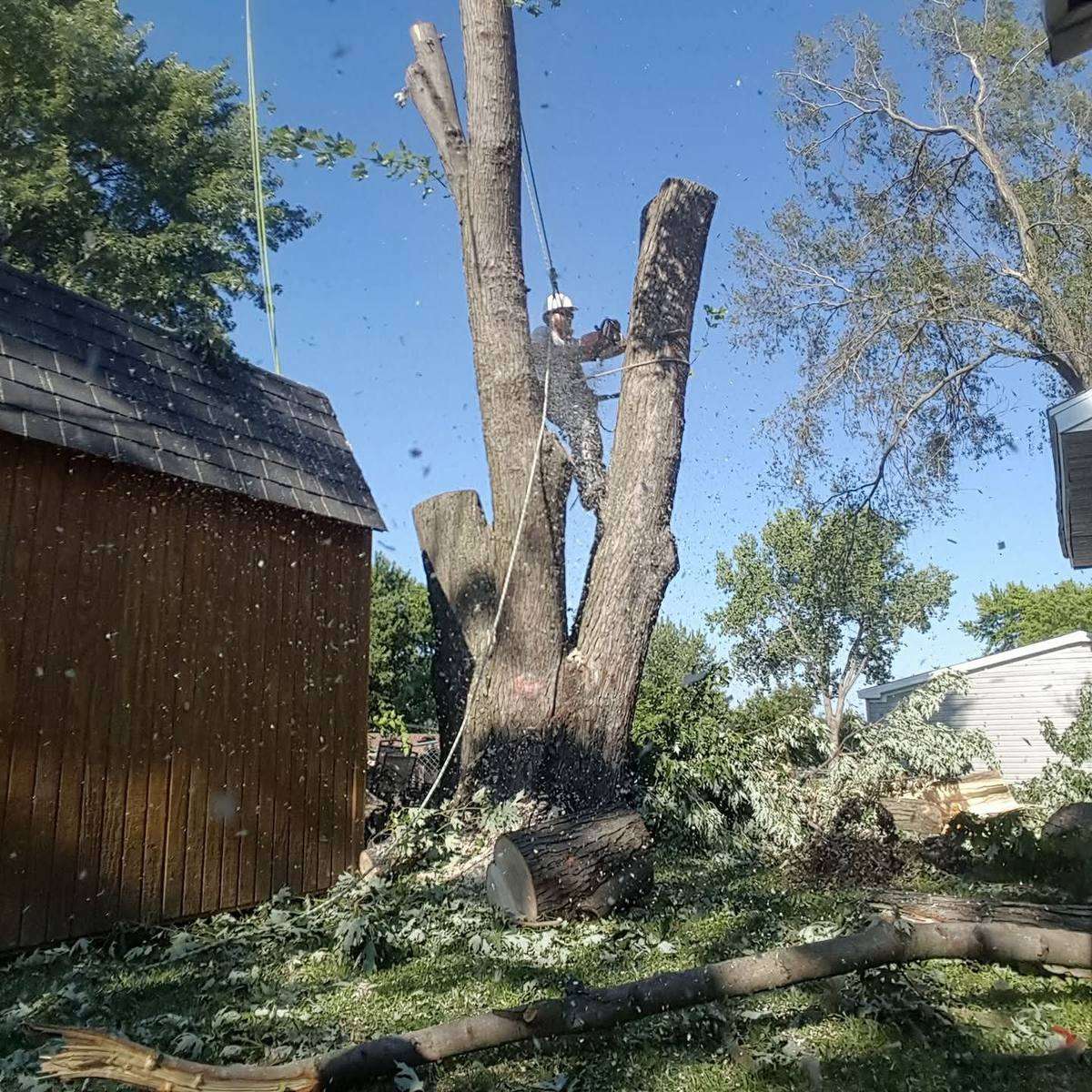
- What is underneath it. A pear in the open backyard can often be dropped in larger pieces. A pear leaning over a roof, fence, driveway or garage has to be taken down in sections with ropes, which takes more time and more people.
- Whether it has already split. A cracked or half failed pear is under tension and is less predictable to cut. That is slower, careful work, and it costs more than the same tree standing whole.
- Power lines. Plenty of older Bradford pears were planted right under the service drop. A tree touching or near overhead lines changes how the job is done and who is allowed to do it. Call Evergy before anyone works near those lines.
- Access. Narrow side yards, gates and soft ground limit what equipment can get to the tree. Late fall and winter often help here, because firm or frozen ground lets equipment in with less damage to the lawn.
- The stump and the sprouts. With a Bradford pear, dealing with the stump is not optional if you want it gone for good. More on that below.
- How many trees. Pears seed themselves. If you have one big tree plus a row of volunteers along the fence, doing them in one visit is usually cheaper per tree than doing them one at a time.
- Cleanup and haul away. Whether you want the brush and wood hauled off, or want the rounds left for firewood, changes the price.
If you want a real number for your pear, call (785) 553-7343 for a free estimate on tree removal. We will tell you what it takes and what the quote includes, with no hidden fees.
The Stump Is the Part Most People Get Wrong
Here is the thing national cost guides skip. A Bradford pear does not die when you cut it down. KDA notes that the species produces a large number of suckers from its shallow roots, so a broken or cut pear can turn into several new trees where there used to be one. That is why the state's recommendation is to cut the tree and treat the stump.
In practice you have two ways to finish the job:
- Stump grinding. We grind the stump below grade so you can reseed or replant. Stump grinding removes the stump itself, but a pear's roots may still push up sprouts in the first season or two, so plan to watch the area and cut or treat anything that comes up.
- Treating the fresh cut. This is what KDA means by treating the stump: a herbicide labeled for cut stump use, applied right after the cut, to keep the roots from resprouting. Follow the product label exactly. As KDA puts it, the label is the law, and it tells you what you have to do, not just what you should do.
Many homeowners do both: treat the stump, then grind it once the roots are dead. Either way, the worst outcome is the most common one, a pear cut to a stump and left alone, which comes back as a thicket.
If volunteer pears have already taken over a fence line, a ditch or the back of a lot, that is a brush removal job, and the same rule applies to every one of those small stumps.
Can You Take Down a Bradford Pear Yourself?
Sometimes, yes. Be honest with yourself about which side of this line your tree is on.
Usually a reasonable DIY job:
- Seedlings and saplings you can pull or cut with a hand saw or loppers
- Small pears, roughly the height of a one story roofline or less, standing in open ground with nothing to hit
- Treating small cut stumps yourself, following the herbicide label
Time to call a crew:
- Anything taller than you can safely drop into open space
- Any pear over or near a house, garage, fence, vehicle or play area
- Any tree touching or near power lines
- A pear that is already cracked, split or hung up in another tree. Split trees store tension, and cuts can release it in unpredictable ways
If you are not sure which group your tree falls into, a quick tree consultation will settle it, and we will tell you if it is a job you can handle yourself.
Free Replacement Trees: The Callery Pear Buyback
Kansas has been paying people back in trees to get rid of their pears. In April 2023, Shawnee County Parks and Recreation, Evergy, Deep Roots KC and the Kansas Forest Service held a buyback at the Gage Park maintenance compound in Topeka and gave away 100 native trees. To qualify, residents removed a Callery pear on their property and sent in a photo of the downed tree. Replacement options included serviceberry, redbud, American smoketree, swamp white oak, bur oak, fragrant sumac and bald cypress.
According to the Kansas Forest Service, it has run four buyback events in the past two years with about 250 participants, and it is looking at offering another one next year. Dates are not announced far ahead, so if you want a free replacement tree, sign up for the Kansas Forest Service's Kansas Canopy newsletter to hear about the next one. Taking your pear down this winter puts you in position to claim a tree when the next event opens. Keep a photo of the tree on the ground, since past events have asked for one.
What to Plant Instead of a Bradford Pear
Most people planted Bradford pears for the spring flowers and the quick shade. You can get both without the splitting. KDA suggests these alternatives, which are either native or have proven they stay where they are planted:
- Serviceberry. White spring flowers, small edible berries birds love, and good fall color. The closest swap for the look of a pear in bloom.
- Eastern redbud. A Kansas favorite with pink purple blooms in early spring. A good size for front yards.
- Flowering crabapple. Heavy spring bloom in white, pink or red, depending on the variety.
- Flowering cherry. Another spring bloomer for smaller spaces.
If you want real shade, the buyback list points the same direction: bur oak and swamp white oak are long lived, strong wooded trees that handle Kansas weather. They grow slower than a pear, but they will not split in half at age 25. One thing we would not plant as a replacement is ash, for the reasons in our post on emerald ash borer in Topeka.
Give the new tree room. Plant it away from the old stump location if you can, out from under power lines, and far enough from the house that its mature canopy will not hang over the roof.
When to Schedule a Bradford Pear Removal
- Late fall and winter (now): The best window. Leaves are off, so the structure and any cracks are easy to see. Ground is firmer for equipment. And you get the tree down before ice season, when pears are most likely to fail. KDA also notes the small, hard fruit softens after it freezes, and birds then eat it and spread the seeds, so a pear removed in late fall has one less winter to seed the neighborhood.
- Before spring bloom: If you are planning to claim a buyback tree, getting the pear down over the winter means you are ready when an event is announced.
- After a storm: If your pear has already split, do not wait for spring. Keep people, pets and vehicles out from under it and call for an assessment. If it already came down, our tree debris removal crew can clear it.
Get a Free Estimate on Your Bradford Pear
Give us a call if any of these sound familiar:
- Your Bradford pear has a crack or seam running down from where the main stems meet
- It has already dropped a large limb, or it leans over the house, driveway or fence
- Volunteer pears are coming up along your fence line or the back of your lot
- You cut a pear down before and the stump keeps sprouting
- You want it gone before the next ice storm, or in time for a buyback tree
Wiki Wood Tree Care is licensed and insured, and we serve Topeka, Lawrence, Silver Lake, Auburn, Tecumseh, Wakarusa and the rest of Shawnee County. Every job includes complete cleanup, and estimates are always free. Call (785) 553-7343 or request an estimate online.