If you have an ash tree in Topeka or anywhere in Shawnee County, emerald ash borer is already in your area. It was confirmed here in 2017, and in 2023 the Kansas Forest Service reported infested trees in 13 Northeast Kansas counties, including Shawnee, Douglas, Jefferson and Osage. The short answer to "treat or remove" comes down to three things: how much of the canopy is already gone, how big and how valuable the tree is, and whether you are willing to keep treating it every two to three years for as long as you own it. A healthy, well placed ash with most of its canopy can often be protected. An ash that has already lost half its crown cannot, and it gets more dangerous to remove the longer it stands.
Below is how to tell which situation you are in, what each path involves, and when each step happens on the Kansas calendar.
Where Emerald Ash Borer Stands in Shawnee County
Emerald ash borer (EAB) is a small, metallic green beetle from Asia. The adults do little harm. The damage comes from the larvae, which tunnel through the thin layer of living tissue just under the bark that carries water and nutrients through the tree. Once enough of that layer is cut, the tree starves from the top down.
A few dates that matter for local homeowners:
- 2012: EAB first found in Kansas.
- 2017: EAB confirmed in Shawnee County.
- 2021: The Kansas Department of Agriculture ended the county EAB quarantines in Shawnee and nine other eastern counties, following a federal rule change. The state shifted its focus to education, survey work and biological control.
- 2023: The Kansas Forest Service confirmed infested trees across 13 Northeast Kansas counties and said the beetle is likely in areas that have not been surveyed yet.
The end of the quarantine did not mean the problem went away. It meant the beetle had spread far enough that moving firewood across county lines was no longer the main thing standing between it and new trees. For a homeowner in Topeka, Lawrence, Silver Lake, Auburn, Tecumseh or Wakarusa, the practical takeaway is simple: assume EAB is close enough to reach your ash.
All of our native ash species are vulnerable, including green ash and white ash, which were planted heavily along Kansas streets and in yards for decades because they grew fast and tolerated tough conditions. According to the Kansas Forest Service, small trees can die within one to two years of infestation, while larger trees may hang on for up to four.
Is It Actually an Ash Tree?
Before anything else, make sure you are dealing with an ash. A lot of trees get called ash that are not, and EAB only attacks true ash (it does not attack mountain ash, which is a different tree entirely). Three quick checks:
- Opposite branching. Branches and buds grow directly across from each other in pairs, not staggered.
- Compound leaves. Each leaf is made of several leaflets, usually five to nine, along a central stem.
- Bark pattern. On mature ash, the bark forms a tight diamond shaped pattern of interlocking ridges.
If you are not sure, a tree consultation will settle it in a few minutes on site.
Signs Your Ash Is Already Infested
The trouble with EAB is that by the time most people notice it, the tree has usually been infested for a few years. Look for these, roughly in the order they tend to show up:
- Thinning at the top of the canopy. Fewer leaves, smaller leaves, and bare twigs starting in the upper crown and working down.
- Woodpecker damage. Woodpeckers feed on the larvae under the bark and strip off patches of the outer bark, leaving lighter colored areas on the trunk and limbs.
- Sprouts along the trunk or at the base. A stressed ash often pushes out clusters of new shoots low on the tree.
- Vertical bark splits. Narrow cracks in the bark, sometimes with S shaped tunnels visible underneath.
- D shaped exit holes. Small holes with one flat side where adult beetles chewed their way out. K-State notes that the native ash and lilac borer leaves round holes, so the D shape is the giveaway.
One or two of these do not automatically mean the tree is lost. What decides that is how much of the canopy is already gone.
Treat or Remove: How to Decide
The guidance from Midwest extension programs lines up closely. Missouri's EAB management guide, adapted from Purdue University's decision guide, says trees with more than 50 percent dieback are unlikely to recover even with treatment. Purdue's own tree removal guidance is a little stricter: once an ash has lost more than about 30 percent of its canopy, it recommends planning for removal.
Put together, that gives you a workable rule of thumb:
| Canopy condition | What it usually means | Typical next step |
|---|---|---|
| Full, healthy canopy, no signs of EAB | Best time to protect the tree, if it is worth keeping | Start preventive treatment in spring, or plan a removal on your schedule |
| Less than about 30 percent thinning | Often still a good treatment candidate | Treat promptly and watch the canopy each summer |
| Roughly 30 to 50 percent thinning | Gray zone. Treatment may slow decline but recovery is uncertain | Get an on site assessment before spending money on treatment |
| More than 50 percent thinning or dead top | Unlikely to recover even with treatment | Plan removal before the wood becomes brittle |
Canopy is not the only factor. A tree is usually worth treating when:
- It is large, healthy and doing real work, like shading the south or west side of the house
- It is planted somewhere with room to grow, not jammed against the foundation, a driveway or power lines
- You are prepared to keep treating it on schedule for years
A small ash, an ash in a poor spot, or one you never particularly liked is usually a better candidate for removal and replanting with something else. Missouri's guide makes the same point: removing unwanted ash before they die can save money.
What Treatment Involves in Kansas
Treatment is a commitment, not a one time fix. A treated ash stays protected only as long as you keep treating it. If you stop, the beetle is still in the neighborhood.
Professional trunk injection
The option the Kansas Forest Service points to as current best practice is a trunk injection of emamectin benzoate, done by a licensed pesticide applicator. One injection lasts two to three years, and re-injecting every other year is the standard recommendation once the beetle is established in an area, which it is here. Missouri's guide puts the best timing soon after the tree leafs out, typically late April to mid May, with early summer as a fallback.
Homeowner soil drench
Over the counter products containing imidacloprid are applied as a soil drench around the base of the tree. According to Missouri's guide, they are labeled for trees under 20 inches in diameter and work best on trees under 15 inches, and they have to be reapplied every year in early spring, roughly late March to mid April. To measure, wrap a tape around the trunk at 4.5 feet off the ground and divide the circumference by about 3.14.
Be realistic about this option. The Kansas Forest Service has said homeowners should not try to treat already infested trees themselves, because over the counter products are less effective. A soil drench is a reasonable choice for a small, healthy ash you want to protect. It is not a rescue plan for a big tree that is already thinning.
Why Waiting Makes Removal Harder and More Expensive
This is the part most homeowners do not hear until it is too late. An ash killed by EAB does not behave like an ash that died of old age. Because the larvae destroy the tissue that moves water, the tree dries out quickly and the structural wood becomes prone to cracking. Purdue's extension specialists point out that those internal breaks are often hidden by the bark, so limbs can drop without warning, and that delaying removal only makes the tree more brittle and the job more dangerous.
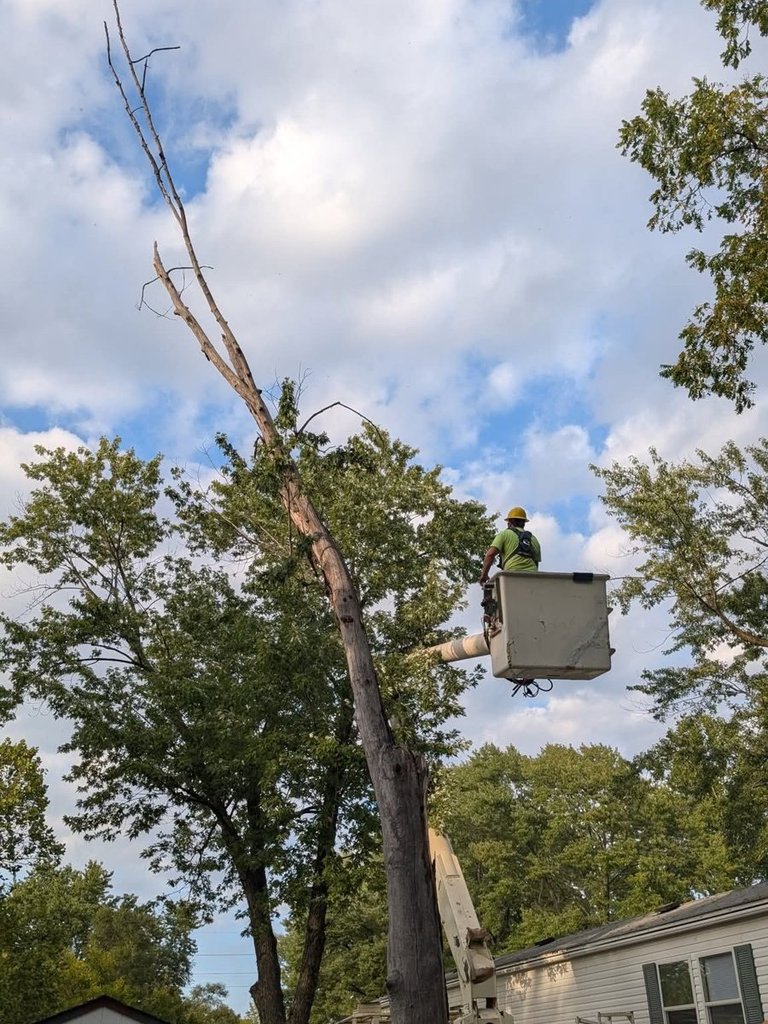
On a removal, that changes everything about how the work gets done. A live ash can usually be climbed and taken down in sections. A dead, brittle ash may not be safe to climb at all, which means more rigging, a bucket truck or other equipment, more time on site and more careful planning around your roof, fence and driveway. All of that shows up in the price. The cheapest time to remove an ash you are not going to save is while it still has leaves on it.
If you already have an ash with a dead top or large dead limbs hanging over the house, do not wait for spring. Stay out from under it, keep kids and pets clear, and call us at (785) 553-7343 for a free estimate on tree removal.
A Kansas Calendar for Ash Owners
- Fall and winter (now): Good time to assess trees after the leaves drop and the structure is easy to see, and a good window to schedule removals of ash you have decided not to keep. Cold, dormant season work is also easier on the lawn.
- Late March to mid April: Homeowner soil drench window for small ash you plan to protect.
- Late April to mid May: Professional trunk injection window, shortly after leaf out.
- Mid to late May: Adult beetles begin emerging, according to the Kansas Forest Service.
- Summer: Walk around each ash and compare the canopy to last year. Thinning from the top down is the signal to reassess.
The fall and winter checks fit naturally alongside the storm prep walk through in our Kansas storm preparation guide, since a declining ash is exactly the kind of tree that fails in a spring thunderstorm or an ice event.
What to Do With the Wood
Even with the quarantine lifted, the advice from state agencies has not changed: keep ash wood local. Missouri's guide recommends disposing of removed ash locally so you do not carry the beetle somewhere new. In practice that means do not haul ash firewood to the lake or a campground in another county, and do not bring firewood home from somewhere else. When we take down an ash, the brush and wood are handled as part of the job, and we can follow up with stump grinding so you can replant in the same area. If you are left with limbs and cleanup after a partial failure, see our tree debris removal service.
When to Call Wiki Wood Tree Care
Give us a call if any of these sound familiar:
- Your ash has a thinning or bare top, or you are seeing woodpecker damage and bark splits
- You are not sure whether your tree is worth treating and want an honest opinion before you spend money
- You have an ash with dead limbs over the house, driveway, fence or a play area
- You have already decided to take an ash down and want it done before it becomes brittle
We serve Topeka, Lawrence, Silver Lake, Auburn, Tecumseh, Wakarusa and the rest of Shawnee County. Estimates are free, and if your ash is healthy and worth keeping, we will tell you that. For live trees you are keeping, we also handle tree pruning to clear out dead wood. Call (785) 553-7343 or request an estimate online.
To report a suspected EAB infestation in an area where it has not been confirmed, the Kansas Forest Service can be reached at 785-532-3300 and the Kansas Department of Agriculture plant protection program at 785-564-6700.